
Fact-Checked & Reviewed for Technical Accuracy
Reviewed for Accuracy
- Author: Bay Area Demolition and Hauling Editorial Team
- Reviewed by: John Alviter
- Reviewer Role: Founder & Lead Demolition Contractor
- Company: Bay Area Demolition and Hauling
- Google Business Profile: Bay Area Demolition and Hauling
- Review Snapshot: As of September 2026, our Google Business Profile shows 271 reviews with a 5.0 average star rating. Because review counts change, homeowners should check the live profile before hiring.
- CSLB License Number: #1123506
- License Classification: C-21 (Building Moving/Demolition)
- Last Reviewed: September, 2026
Review Scope:
- Comprehensive technical verification of structural demolition workflows
- California Contractors State License Board (CSLB) licensing rules
- Bay Area Air Quality Management District (BAAQMD) Regulation 11 Rule 2 compliance
- Cal/OSHA workplace safety standards
- Municipal code enforcement procedures across Northern California.
- Readers can independently verify license standing via the official CSLB Instant License Check.
Regulatory Standards Cross-Referenced:
- California Building Code (CBC Title 24)
- BAAQMD Regulation 11 Rule 2
- Cal/OSHA Construction Safety Orders (8 CCR § 1529)
- CSLB Business & Professions Code § 7110
- Municipal Code Enforcement Guidelines for Santa Clara, San Mateo, Alameda, and San Francisco Counties.
Accuracy and Legal-Safety Disclaimer
This guide provides general educational information for Bay Area property owners, real estate investors, realtors, and property managers. It does not constitute formal legal advice, structural engineering approval, an official insurance policy interpretation, or a binding municipal ruling. Building codes, permit fee multipliers, administrative fines, and enforcement protocols vary by municipality, county, property type, and project scope. Always confirm specific permit requirements and code enforcement steps with your local authority having jurisdiction before starting, altering, or resuming any demolition activity.
Bottom Line Up Front (BLUF)
If you are planning or currently managing a project in the San Francisco Bay Area—whether tearing down a dilapidated backyard garage, knocking out an interior wall to open up a kitchen, or stripping a bathroom down to the studs—performing demolition without required permits can trigger immediate enforcement. Depending on your location and the scope of work, oversight may involve local city code enforcement, the Bay Area Air Quality Management District (BAAQMD), the California Contractors State License Board (CSLB), and Cal/OSHA.
Potential consequences range from posted Stop Work Orders and 2x to 5x retroactive permit penalty fees to daily administrative fines, complications with property insurance claims, and title disclosures that can delay or derail a future home sale or refinance.
If you receive a Stop Work Order or discover unpermitted work on a property you own or manage, the most critical first step is to cease all work immediately, secure the site for safety, document current conditions, and consult with your local building department or a licensed California contractor before moving materials or attempting repairs.
Why Trust This Guide?
Dealing with a municipal code violation or finding a bright red Stop Work Order taped to your front door can feel overwhelming. We wrote this guide to replace panic with clear, practical steps backed by real contractor experience.
Hi, I’m John Alviter, owner of Bay Area Demolition & Hauling. As a licensed Class C-21 Building Moving and Demolition contractor (CSLB #1123506), my team and I spend every day on job sites across Santa Clara, San Mateo, Alameda, and San Francisco counties. We regularly coordinate with local building inspectors, certified asbestos consultants, structural engineers, and utility crews to keep projects safe, legal, and running smoothly.
Our goal is to share what happens behind the scenes during code enforcement—giving you calm, source-backed clarity without scare tactics or generic fluff.
What This Article Does Not Cover
To set clear boundaries and ensure you get the exact help you need, please keep in mind that this guide does not provide:
- Formal Legal Representation: We are experienced contractors, not attorneys. If you face criminal code charges, tenant disputes, or formal litigation, speak with a qualified California real estate or land-use lawyer.
- Insurance Policy Guarantees: Insurance coverage decisions depend entirely on your specific carrier, policy endorsements, and the details of your claim.
- Stamped Engineering Approvals: Only a licensed California Professional Engineer (PE) or Structural Engineer (SE) can perform load calculations or sign off on structural framing changes.
- Official Asbestos & Lead Clearances:
- Asbestos surveys, sampling oversight, and clearance documentation should be handled by a Cal/OSHA-Certified Site Surveillance Technician (CSST), Certified Asbestos Consultant (CAC), or other properly qualified asbestos professional, depending on the scope of work and local requirements.
- Lead inspections/clearance must be handled by a CDPH-certified Lead Inspector/Assessor or other CDPH lead-related construction professional.
- Final Municipal Rulings: Local building officials hold ultimate authority regarding code compliance, fee adjustments, and permit approvals in their respective cities.
What Counts as Unpermitted Demolition?
Property owners are often surprised to learn that California building codes treat structural dismantling with the same engineering scrutiny as new construction. In the eyes of local building departments, knocking down a wall, tearing off a roof structure, or severing utility lines isn’t just “prep work”—it’s a regulated trade that directly impacts public safety, environmental health, and structural integrity.
While exact permit thresholds vary by city, any work that alters load-bearing elements, touches utility systems, or disturbs potential asbestos or lead-containing materials typically requires prior authorization.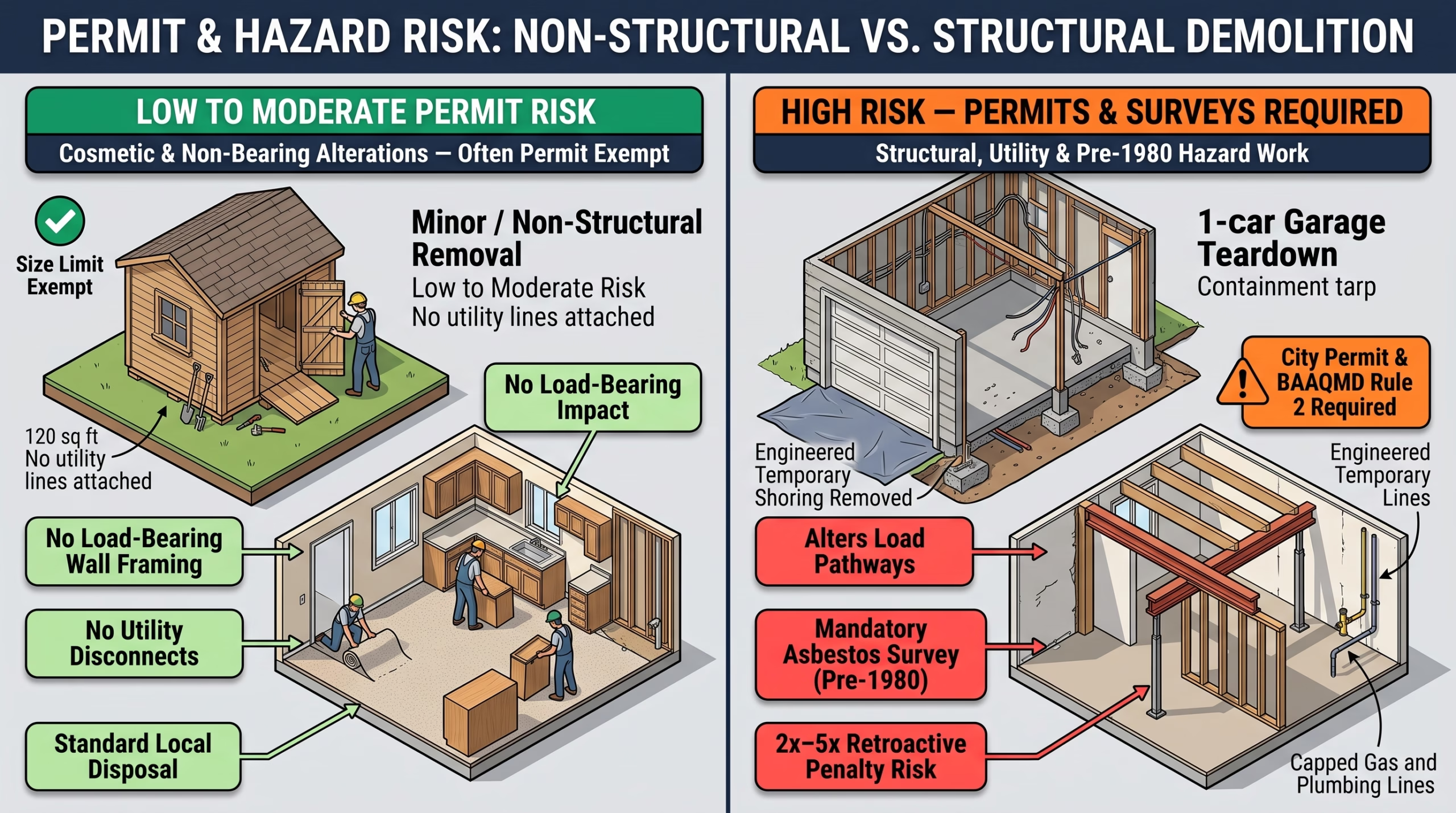
| Work Type | Permit Risk Level | Why It Matters | Who to Ask Before Starting | Common Bay Area Example |
|---|---|---|---|---|
| Detached Shed Removal (<120 sq. ft.) | Low to Moderate | Often exempt from building permits if under size limits and lacking utilities, but planning setbacks still apply. | Local City Planning Dept. | Removing a 10×10 single-story garden shed with no electrical wiring. |
| Detached Garage Removal (>120 sq. ft.) | High | Involves structural footings, property line setbacks, and potential electrical/gas connections. | City Building Dept. & BAAQMD | Demolishing a 1940s 1-car detached garage in San Jose or Oakland. |
| Interior Non-Bearing Wall Removal | Moderate | Electrical wiring, plumbing stacks, or gas lines can run inside the cavity even if the wall isn’t load-bearing. | City Building Dept. | Opening up a partition wall between a kitchen and living room in a 1970s ranch home. |
| Load-Bearing Wall Removal | High | Alters structural load pathways, requiring temporary engineered shoring and beam calculations. | Building Dept. & Structural Engineer | Removing a central hallway wall to create an open-concept living space. |
| Kitchen or Bathroom Full Gut | Moderate to High | Frequently exposes hidden plumbing, electrical lines, and asbestos in tile underlayment or drywall joint compound. | Building Dept. & Certified Hygienist | Stripping a pre-1978 bathroom down to the studs during a remodel. |
| Utility Disconnection / Cap-Off | High | Improperly capping gas, water, or sewer lines creates severe fire, flood, and environmental hazards. | Local Utility (e.g., PG&E) & City | Disconnecting sewer or gas service at the property line before main structure removal. |
| Popcorn Ceiling / Acoustic Texture Removal | High | High probability of asbestos-containing materials (ACM) in homes constructed before 1980. | BAAQMD & Certified Hygienist | Scraping textured ceilings across 1,500 sq. ft. of residential space. |
Contractor Note: Never assume interior work stays invisible. When a large roll-off debris box sits in your driveway filled with lath, plaster, or framing lumber, it frequently prompts neighbor calls or routine spot-checks from passing city inspectors.
10 Checks That Prevent Demolition Violations
Preventing a violation is far easier, cheaper, and less stressful than resolving one after a Stop Work Order is posted. Before taking down a wall or hiring a crew, run through this 10-step checklist:
- Verify Permit Exemptions First: Call or visit your local building counter to confirm whether your exact scope requires a formal building or demolition permit.
- Check Planning and Setback Rules: Confirm that removing or altering a structure won’t violate property-line setbacks, historic preservation overlays, or easements.
- Schedule an Asbestos & Lead Survey: If your home or structure was built before 1980 (or under pre-1978 Cal/OSHA rules), hire a certified specialist to sample suspected materials before disturbing them.
- Submit Your BAAQMD Notification (The 10-Day Rule): For structural demolitions involving load-bearing members, ensure a notification is filed with BAAQMD at least 10 business days before work starts—even if testing shows no asbestos is present.
- Coordinate Utility Cap-Offs: Get written sign-offs from PG&E and your local water/sewer districts confirming utilities are safely turned off and capped at the property boundary.
- Verify Contractor Licenses: Confirm your contractor holds an active Class C-21 (Building Moving/Demolition) or Class A (General Engineering) license via the CSLB License Verification Tool.
- Request Proof of Insurance: Ask for a Certificate of Insurance showing active Workers’ Compensation and General Liability coverage.
- Confirm Permitted Waste Haulers: Make sure your debris box provider is an authorized hauler compliant with your city’s Construction & Demolition (C&D) recycling ordinances.
- Document Pre-Existing Conditions: Take detailed photos of surrounding structures, driveways, sidewalks, and property lines before any work begins.
- Keep Permits Posted On-Site: Maintain physical copies of approved permits, BAAQMD J-numbers, and hazardous survey reports on the job site at all times.
The Multi-Agency Regulatory Web
When unpermitted demolition is flagged in the Bay Area, enforcement rarely comes from a single agency. Multiple agencies hold overlapping jurisdiction, each with its own enforcement focus, inspection rules, and penalty structures.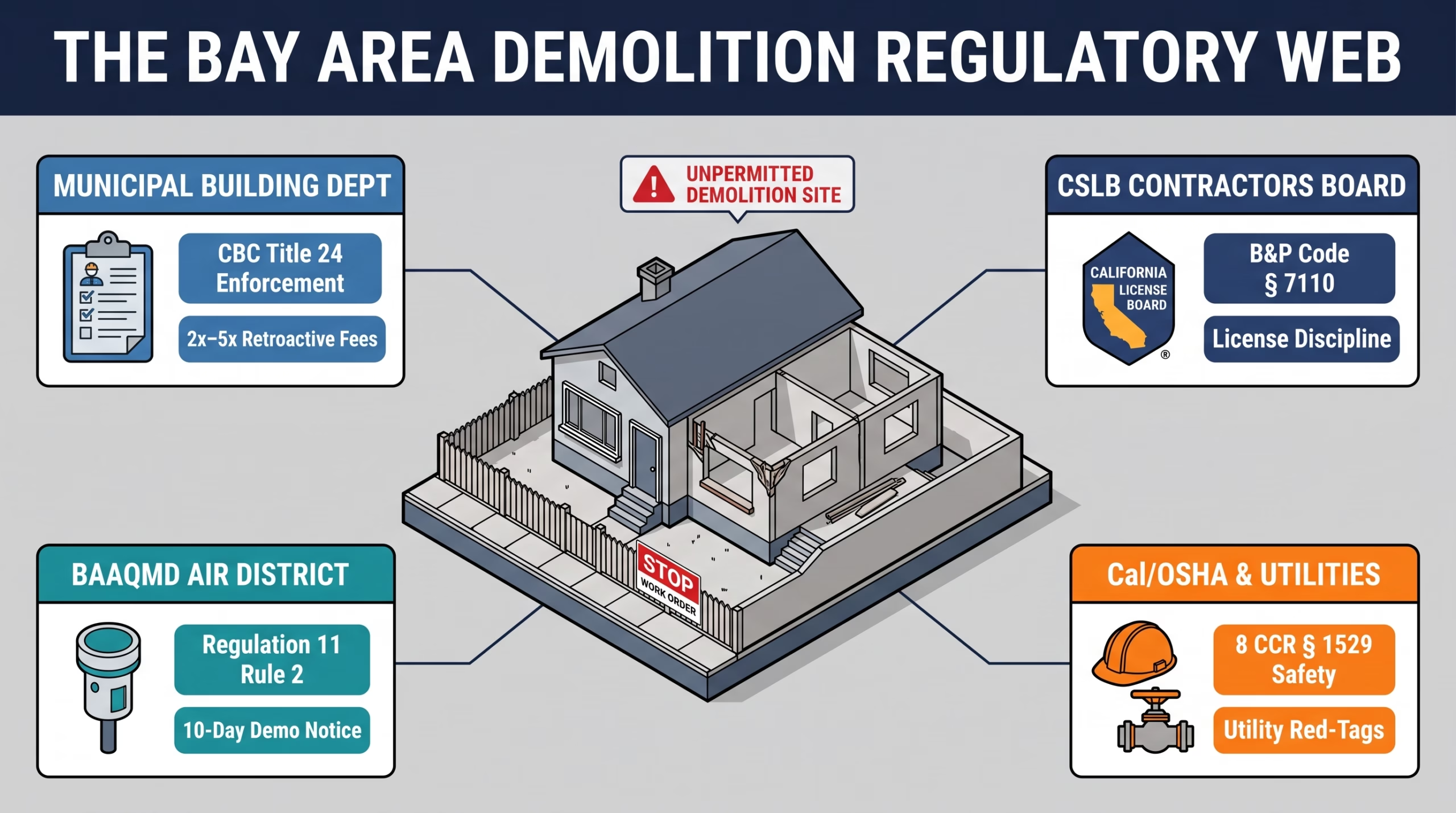
1. Municipal Building Departments City/County Level)
- What They Regulate: Enforcement of the California Building Standards Code (CBC Title 24) and local municipal codes.
- When They Get Involved: Whenever unpermitted structural alterations, safety hazards, or public nuisance complaints are flagged.
- What They Can Require: Immediate Stop Work Orders, retroactive permit penalty fees (often double to quintuple standard rates), engineered as-built plans, selective wall or foundation exposure, and site stabilization.
- Where to Verify: Your local city or county building department portal (e.g., San Jose Building Permits, San Francisco DBI, or Oakland Planning & Building).
2. Bay Area Air Quality Management District (BAAQMD)
- What They Regulate: Regional air quality, toxic air contaminants, and hazardous dust control under BAAQMD Regulation 11, Rule 2.
- The 10-Business-Day Rule: BAAQMD rules require property owners or contractors to submit an official notification at least 10 business days before starting any demolition involving a load-bearing structural member—regardless of whether asbestos is present.
- What They Can Require: Immediate site shutdowns, mandatory asbestos testing, hazardous material abatement containment, and civil administrative fines that can reach $10,000 or more per day for serious or willful non-compliance.
- Where to Verify: Official BAAQMD Asbestos & Demolition Guidelines.
3. Contractors State License Board (CSLB)
- What They Regulate: Licensing, bonding, and professional compliance for California construction contractors.
- When They Get Involved: When unlicensed individuals perform demolition work valued over $1,000, or when licensed contractors willfully perform work without required permits.
- Statutory Authority: Under California Business and Professions Code § 7110, deliberate disregard of local building laws is grounds for disciplinary action, license suspension, or administrative citations.
- Where to Verify: CSLB License Law & Regulations.
4. Cal/OSHA (Division of Occupational Safety & Health)
- What They Regulate: Worker health and safety under California Code of Regulations Title 8 (specifically 8 CCR § 1529 for construction asbestos exposure).
- When They Get Involved: When workers are exposed to uncontained dust, fall risks, unstable framing, or hazardous materials.
- What They Can Require: Order Prohibiting Use (POU) stop-work orders, workplace safety citations, and mandatory health monitoring.
- Where to Verify: Cal/OSHA Asbestos Unit.
5. Utility Providers (PG&E, Municipal Water & Sanitation)
- What They Regulate: Safe connection, metering, and shut-off of electrical, natural gas, water, and sewer infrastructure.
- When They Get Involved: Unpermitted excavation or structural demolition near active utility lines.
- What They Can Require: Emergency lockouts, line isolation fees, and mandatory safety clearance inspections before restoring service.
Source-Backed Penalty Matrix
The legal and financial consequences of unpermitted demolition vary based on jurisdiction, hazard severity, and whether asbestos or lead was disturbed.
Note: The penalty ranges below reflect potential outcomes outlined in California codes and municipal guidelines. Verify exact fees with your local building department.
| Violation / Issue | Responsible Agency | Possible Consequence | What Determines Severity | Official Citation / Source | First Corrective Step |
|---|---|---|---|---|---|
| Unpermitted Structural Demolition | City / County Building Dept. | Stop Work Order; 2x to 5x retroactive permit penalty fees. | Scope of work, municipal fee schedule, past property violations. | Local Municipal Code; CBC Title 24. | Halt work immediately; contact the issuing building inspector. |
| Failure to File BAAQMD Notice | BAAQMD | Civil administrative fines up to $10,000+/day in serious cases. | Material quantity, RACM presence, speed of remediation. | BAAQMD Regulation 11, Rule 2. | Order an immediate asbestos survey from a certified specialist. |
| Unlicensed Contractor Operations | CSLB / District Attorney | Administrative citations, license denial, or misdemeanor charges. | Project value, repeat offenses, worker exposure hazards. | CA B&P Code § 7028 & § 7110. | Stop unlicensed work; hire a licensed C-21 or Class A contractor. |
| Unsafe Asbestos Disturbance | Cal/OSHA & BAAQMD | Worksite closure (POU notice), mandatory abatement, fines. | Airborne fiber counts, worker exposure levels, containment. | 8 CCR § 1529; CA Health & Safety Code § 25915. | Seal off the area; hire a licensed C-22 abatement contractor. |
| Unpermitted Utility Disconnect | Local Utility / City | Emergency utility lockouts, red tags, repair charges. | Immediate fire or explosion risk, severity of line damage. | Local Utility Rules; CA Gov Code § 4216. | Call utility emergency line to schedule safe cap-offs. |
| Property Sale / Refinance Hold | Buyer Lender / Title Co. | Escrow delays, requested repair credits, or loan refusal. | Open code violations, non-disclosure claims on disclosure forms. | CA Civil Code § 1102. | Resolve the violation and secure a final city sign-off letter. |
Bay Area Jurisdiction Differences: What to Verify Before You Start
Demolition rules and permit workflows differ across Bay Area cities and counties. Below is a snapshot of key local requirements:
How City Inspectors Catch Unpermitted Work
Property owners often wonder how cities find out about unpermitted demolition, especially if it happens behind a fence or inside a home. In reality, municipal code enforcement relies on several connected tracking methods:
- Automated Waste Hauler Tracking: Many Bay Area cities require franchised waste haulers (Recology, Republic Services, Waste Management) to log commercial roll-off dumpster placements. A dumpster delivered to a residential address without an active building permit frequently prompts a routine site visit from a city inspector.
- Neighbor Inquiries and Calls: Most code enforcement visits start with a phone call or online report from a neighbor concerned about noise before allowed hours, dust drifting across property lines, blocked street parking, or large debris piles.
- GIS Mapping and Aerial Imagery: Cities periodically cross-reference high-resolution aerial flyover imagery against active building permit databases to catch unpermitted additions, expanded footprints, or missing outbuildings.
- Utility Disconnect Notifications: When you request a gas or electric meter disconnect or water main shut-off through PG&E or your city water department, those safety records often notify the building department that demolition is underway.
- Routine Inspector Patrols: Building inspectors driving between scheduled job sites routinely stop when they see roll-off boxes, heavy machinery, or exposed framing in residential neighborhoods.
What to Do When Issued a Stop Work Order (First 48 Hours)
Finding a red Stop Work Order taped to your job site can be stressful, but taking methodical, calm steps during the first 48 hours will help you resolve the situation as quickly and smoothly as possible.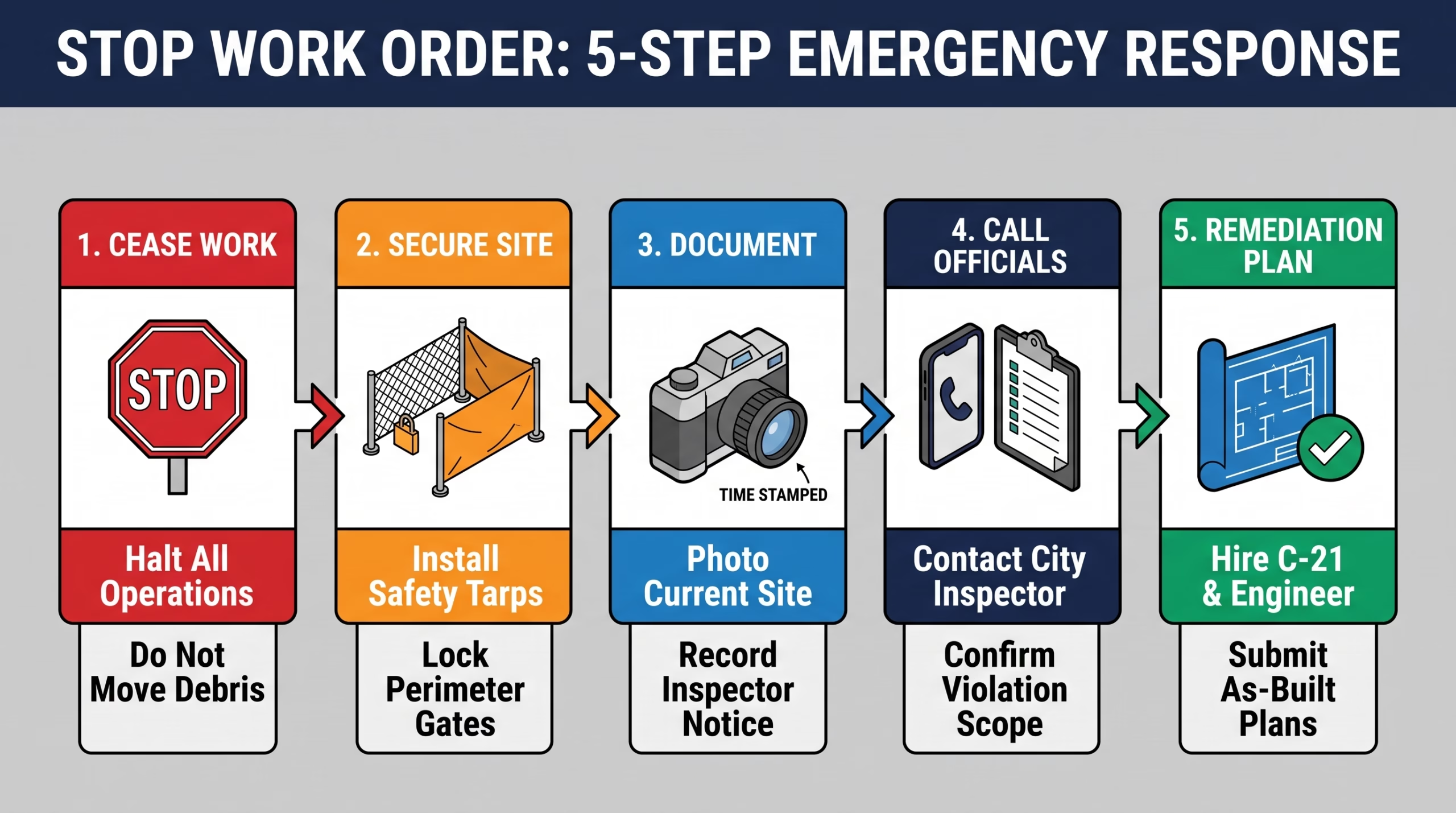
Step 1: Immediately Stop All Work
- Action: Direct all workers to stop immediately.
- Warning: Continuing work after a Stop Work Order is posted can lead to increased administrative fines, frozen permit applications, or misdemeanor citations under local municipal codes.
Step 2: Secure and Stabilize the Site
- Action: Make sure the job site is safe for occupants, neighbors, and the public.
- Allowed Actions: You are generally allowed—and expected—to handle basic site safety, such as closing security gates, covering loose dirt or debris with tarps, and securing perimeter fencing.
- Contractor Note: Do not haul debris away or attempt to cover up structural alterations after a Stop Work Order is posted unless the inspector gives you explicit written permission. Moving materials can be viewed as tampering with evidence.
Step 3: Document Everything
- Action: Take clear, time-stamped photos and videos of the entire site in its exact current state.
- What to Photograph: Capture exposed framing, utility disconnect points, dust barriers, property line fences, and the posted Stop Work Order notice.
Step 4: Contact the Issuing Inspector
- Action: Read the notice carefully to find the specific code sections cited, the inspector’s name, and their phone number or email address.
- How to Reach Out: Call or email the inspector calmly. Let them know you have stopped all work, secured the site for safety, and want to confirm the exact steps needed to resolve the violation.
Step 5: Put Together Your Remediation Team
- Action: Depending on the violation, assemble the licensed professionals needed to draft a corrective plan for the city.
“Who to Call First” Decision Checklist
Use this quick decision guide to figure out which professional to reach out to first after securing your job site: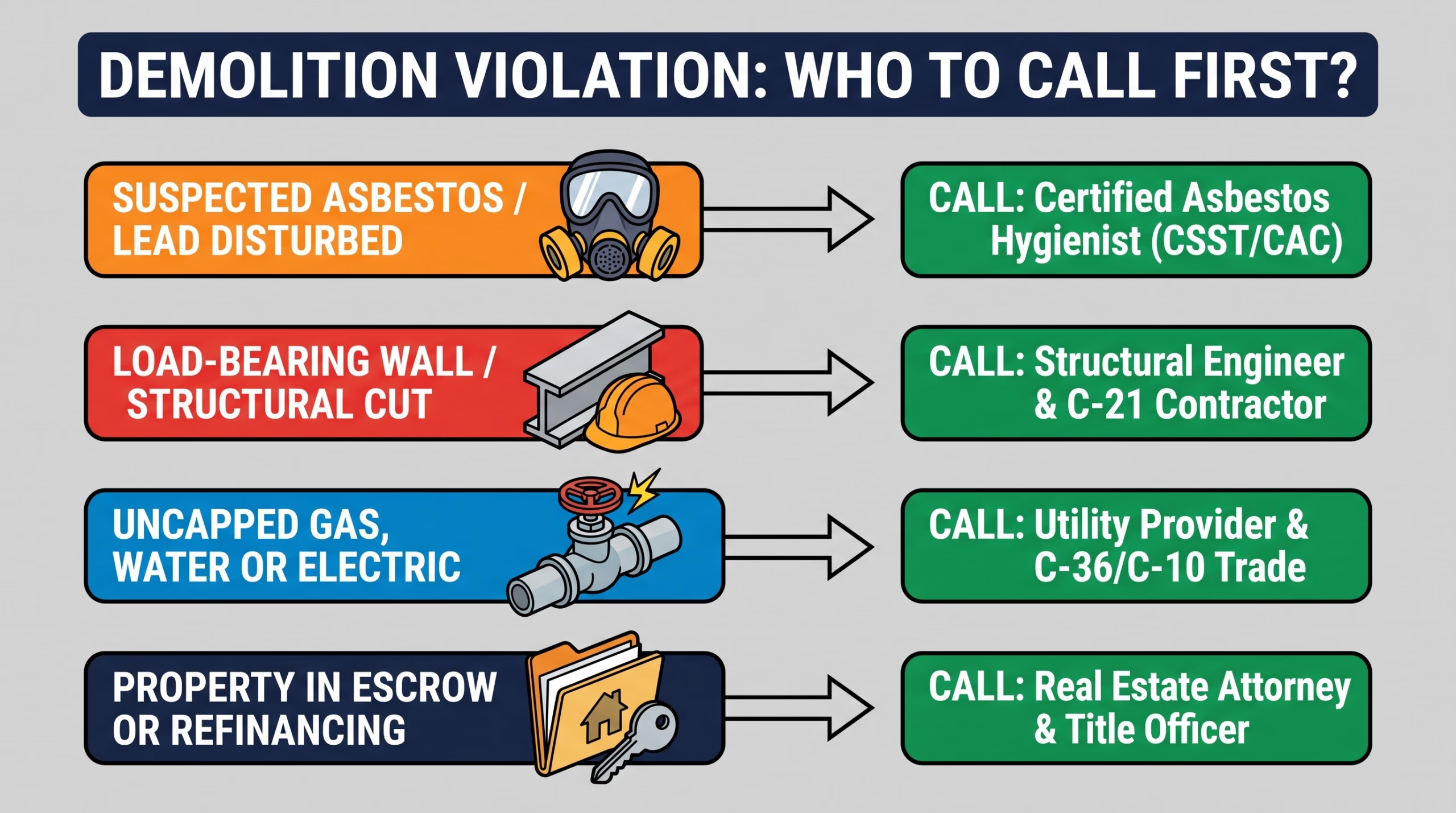
- Has an active Stop Work Order been posted on your property?
- Yes: Stop work immediately, take photos of current conditions, and call the issuing building inspector directly.
- Were pre-1980 building materials (drywall, tile, acoustic plaster) disturbed without a survey?
- Yes: Contact a Certified Site Surveillance Technician (CSST) or Certified Industrial Hygienist (CIH) to test materials before anyone touches the debris.
- Were load-bearing walls, roof trusses, or foundation footings removed or modified?
- Yes: Reach out to a licensed California Structural Engineer and a Class C-21 Demolition Contractor to evaluate temporary shoring and draft as-built plans.
- Were gas, water, electric, or sewer lines cut or capped without permits?
- Yes: Call your utility provider’s emergency service line and a licensed trade contractor (Class C-36 Plumbing or Class C-10 Electrical).
- Is the property currently in escrow, listed for sale, or undergoing refinancing?
- Yes: Inform your real estate agent and title officer to ensure proper disclosures under California Civil Code § 1102.
Retroactive Permitting and Legalization (“As-Built” Process)
Legalizing unpermitted demolition—often called getting an “as-built” or retroactive permit—requires proving to your city building department that the completed work complies with current California Building Code standards.
What the City May Require for Approval
- Selective Wall or Soil Exposure: Inspectors may require “destructive testing” or selective exposure—like opening small drywall sections or excavating soil near footings—to inspect framing, plumbing caps, or foundation conditions.
- Structural Engineering Sign-Off: If load-bearing elements were removed, a licensed California Structural Engineer must run load calculations and provide a stamped engineering letter confirming structural stability.
- Environmental & Asbestos Clearances: A formal clearance report from a certified asbestos specialist or a valid BAAQMD J-number verifying that hazardous materials were handled safely.
- C&D Disposal Receipts: Weight tickets and recycling receipts showing compliant waste disposal under your city’s Construction & Demolition recycling ordinance.
Documentation Packet Checklist for City Meetings
When you attend your initial meeting or plan-check submittal with the building department, bring a clean binder or organized digital folder with the following documents:
- [ ] Copy of the posted Stop Work Order or Correction Notice.
- [ ] Time-stamped photographs showing pre-existing conditions and current site stabilization.
- [ ] Written Scope of Work explaining exactly what was removed and what remains.
- [ ] Certified Asbestos and Lead Survey Report from a CSST/CAC (if applicable).
- [ ] BAAQMD Notification Form and approved J-number printout (if applicable).
- [ ] Written Utility Cap-Off Receipts from PG&E or municipal water/sewer districts.
- [ ] C&D Debris Recycling Receipts from an authorized processing facility.
- [ ] Stamped Engineering Calculations or as-built drawings from a licensed engineer.
- [ ] Contractor license details, bonding, and proof of active Workers’ Compensation insurance.
- [ ] Completed Retroactive Building Permit Application and fee payment method.
Contractor Reality Check: Why DIY & Unpermitted Demo Costs More
Homeowners and real estate investors sometimes consider skipping permits or doing DIY demolition to save money on upfront engineering, testing, and permit fees. However, if unpermitted work gets caught, fixing it retroactively will cost double, sometimes triple, what it would cost to do the project correctly with proper permits from day one.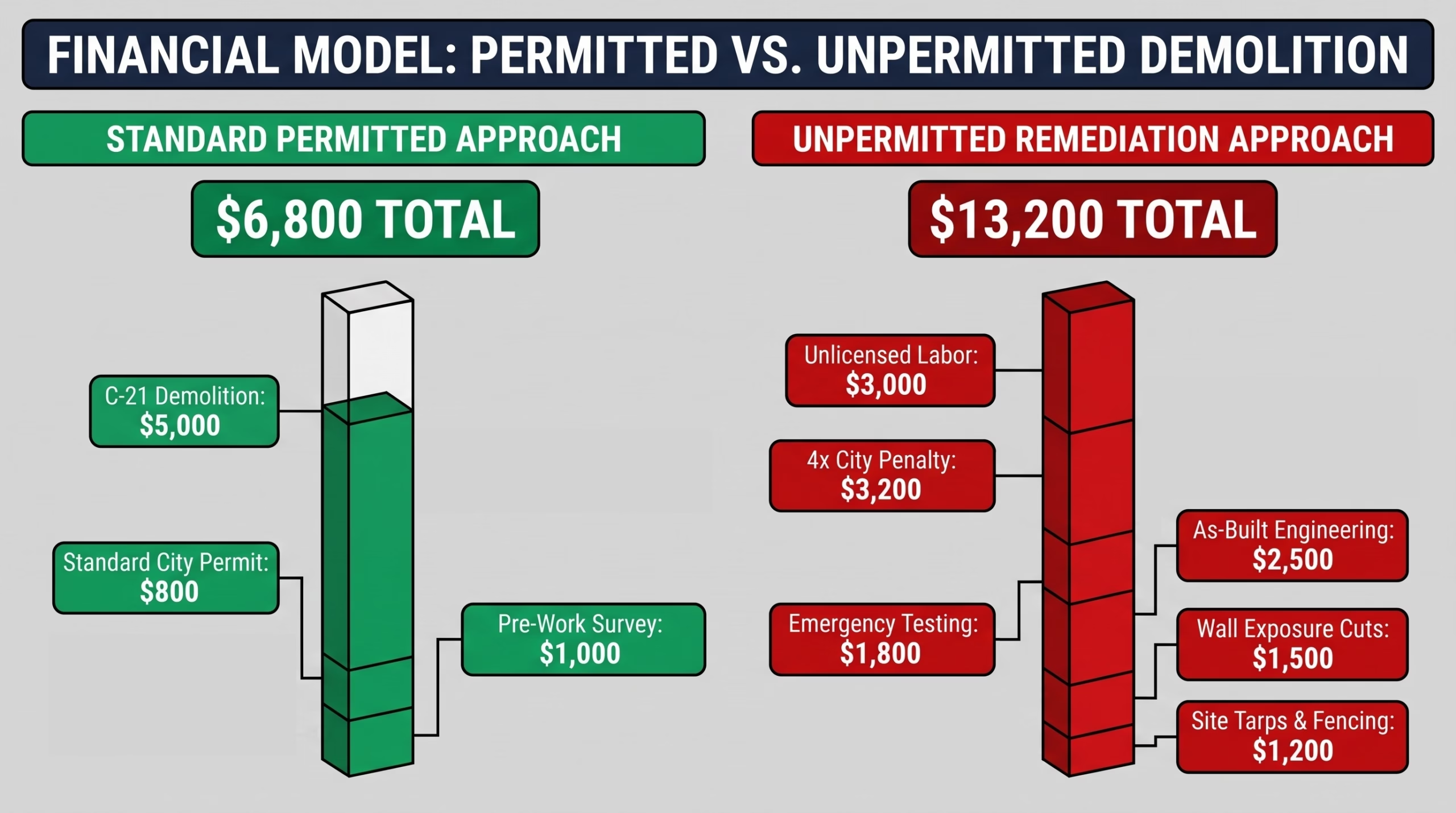
Hypothetical Financial Comparison Model
| Expense Category | Standard Permitted Approach | Unpermitted Remediation Approach |
|---|---|---|
| Initial Demolition Contractor | $2,500-$5,000 (Licensed C-21 crew) | $3,000 (Unlicensed / DIY labor) |
| City Permit & Plan Review Fees | $800 (Standard fee) | $3,200 (4x retroactive penalty fee) |
| Asbestos & Lead Testing | $1,000 (Pre-work survey) | $1,800 (Emergency testing + air sampling) |
| Structural Engineering Review | $0 (Not needed for simple demo) | $2,500 (As-built calculations & letter) |
| Selective Wall Exposure / Remediation | $0 | $1,500 (Drywall cuts for inspector review) |
| Professional Site Stabilization | $0 | $1,200 (Emergency fencing & tarps) |
| Estimated Total Cost | $6,400 | $13,200 (More than double original cost) |
Contractor Note: Working with a licensed C-21 demolition contractor doesn’t eliminate every challenge, but it helps ensure permits are handled through the correct process, provided the contractor submits accurate information and follows city requirements.
Real-World Scenarios (Hypothetical Compliance Cases)
To see how code enforcement plays out in real life, review these three typical Bay Area hypothetical cases:
Scenario A: Unpermitted Detached Garage Removal in San Jose
- What Happened: A homeowner hired an unlicensed handyman to tear down an aging 200 sq. ft. wooden garage. A neighbor called code enforcement about dust and early-morning noise.
- Agencies Involved: City of San Jose Code Enforcement and BAAQMD.
- The Violation: No building/demolition permit on file; no BAAQMD 10-day notification filed before removing load-bearing structural members.
- Possible Outcome: San Jose posted a Stop Work Order and charged a 3x permit penalty. BAAQMD issued an inquiry requiring an immediate retroactive asbestos survey. Work was delayed 5 weeks while testing was completed and as-built site plans were reviewed.
Scenario B: Unpermitted Interior Wall Removal in San Francisco
- What Happened: An investor renovating a 1920s flat in San Francisco removed an interior hallway wall, assuming it wasn’t load-bearing. A city inspector visiting an adjacent permitted unit noticed debris boxes and inspected the site.
- Agencies Involved: San Francisco Department of Building Inspection (DBI).
- The Violation: Unpermitted structural alteration and unpermitted debris hauling.
- Possible Outcome: SF DBI issued a Notice of Violation (NOV). The investor had to hire a licensed Structural Engineer to submit calculations and install temporary shoring, leading to significant plan-check delays and administrative fees.
Scenario C: Unintentional Asbestos Disturbance during Kitchen Remodel
- What Happened: An Oakland homeowner started pulling up old linoleum tile and tearing out drywall in a pre-1978 kitchen before pulling permits.
- Agencies Involved: Oakland Planning & Building Department and Cal/OSHA.
- The Violation: Failure to complete a pre-demolition hazardous materials survey.
- Possible Outcome: Testing revealed 5% chrysotile asbestos in the flooring mastic. All work was stopped, and the owner had to hire a licensed C-22 hazardous abatement contractor to perform full containment cleanup under negative air pressure before standard permit processing could resume.
When to Get Professional Help Immediately (Red Flags)
Reach out for qualified professional help right away if your project involves any of these critical red flags:
- Red Flag 1: Exposed Structural Alterations. Main posts, joists, foundation footings, or load-bearing wall studs were cut or removed.
- Who to call: Licensed Structural Engineer and C-21 Demolition Contractor.
- Red Flag 2: Suspected Asbestos or Lead Disturbed. Pre-1980 drywall joint compound, flooring mastic, pipe insulation, or popcorn ceiling was torn open without testing.
- Who to call: For suspected asbestos, contact a Certified Asbestos Consultant or Certified Site Surveillance Technician.
- Who to call: For suspected lead paint or lead dust, contact a CDPH-certified Lead Inspector/Assessor or qualified lead-related construction professional.
- Red Flag 3: Active Stop Work Order Posted. A red tag or official violation notice is posted on the property.
- Who to call: Issuing City Building Inspector and a licensed California contractor.
- Red Flag 4: Uncapped Utilities. Live electrical wiring, gas lines, or water mains were cut or left exposed without utility sign-offs.
- Who to call: Utility Emergency Line (e.g., PG&E) and a licensed Class C-36 Plumbing or Class C-10 Electrical contractor.
- Red Flag 5: Pending Property Sale or Refinance. The home is in escrow, listed for sale, or undergoing refinancing while code violations are open.
- Who to call: Real estate attorney and real estate broker to manage required disclosures under California law.
Frequently Asked Questions
1. Can I remove a small backyard shed without a building permit in the Bay Area?
In many Bay Area cities, single-story detached accessory structures (like tool sheds) under 120 square feet don’t require a building permit, as long as they don’t have electrical, plumbing, or gas lines. However, planning setbacks, property line rules, and height limits still apply. Always double-check size limits with your local planning counter before starting.
2. Does interior demolition always require a permit?
Not always, but major interior demolition—like removing framed walls, gutting kitchens down to studs, or touching plumbing stacks and electrical wiring—generally requires a combination building permit. Cosmetic non-structural work, like pulling up carpet or removing freestanding cabinets, typically doesn’t require a permit.
3. Do I need to notify BAAQMD if my asbestos survey comes back completely clean?
Yes. Under BAAQMD Regulation 11, Rule 2, notification is mandatory at least 10 business days before starting any structural demolition involving load-bearing elements, regardless of whether asbestos is present.
4. What should I do first if a Stop Work Order is posted on my door?
Immediately instruct all workers to stop work. Secure the job site so it is safe from weather and public hazards, photograph current site conditions, and call the issuing building inspector listed on the notice to confirm the compliance path.
5. Can I clean up or haul away debris after receiving a Stop Work Order?
Do not haul away debris unless the building inspector gives you explicit written permission. Inspectors often need to examine discarded materials to determine the original scope of work and confirm whether hazardous materials were present.
6. How long does it typically take to resolve a retroactive permit violation?
Resolving a retroactive permit violation usually takes 3 to 8 weeks, depending on municipal plan-check backlogs, whether structural engineering plans are needed, and how quickly hazardous testing reports can be completed.
7. Can I pull a retroactive demolition permit statewide as an Owner-Builder?
California law allows property owners to pull permits as an Owner-Builder. However, doing so means you assume direct legal responsibility for job-site safety, workers’ compensation liabilities, BAAQMD compliance, and code compliance.
8. Will property insurance cover damage caused during unpermitted demolition?
Coverage depends on your specific policy language. Many standard property insurance policies exclude loss or damage resulting from illegal acts, intentional damage, or unpermitted structural alterations. Consult your insurance agent or attorney for policy interpretations.
9. What is the difference between a C-21 license and a General B license for demolition?
A Class C-21 Building Moving/Demolition license is a specialized California classification dedicated specifically to structural dismantling, hazard containment, and heavy machinery demolition. A Class B General Building contractor can only perform demolition if the work is part of a larger construction project involving two or more unrelated building trades.
10. What happens if asbestos was accidentally disturbed during demolition?
If suspected asbestos-containing materials were disturbed without containment, halt work immediately, evacuate the area, and retain a Certified Site Surveillance Technician (CSST) to perform air monitoring and bulk sampling. If contamination exists, a licensed C-22 hazardous abatement contractor must perform professional cleanup under negative pressure.
Final Reader Action Summary
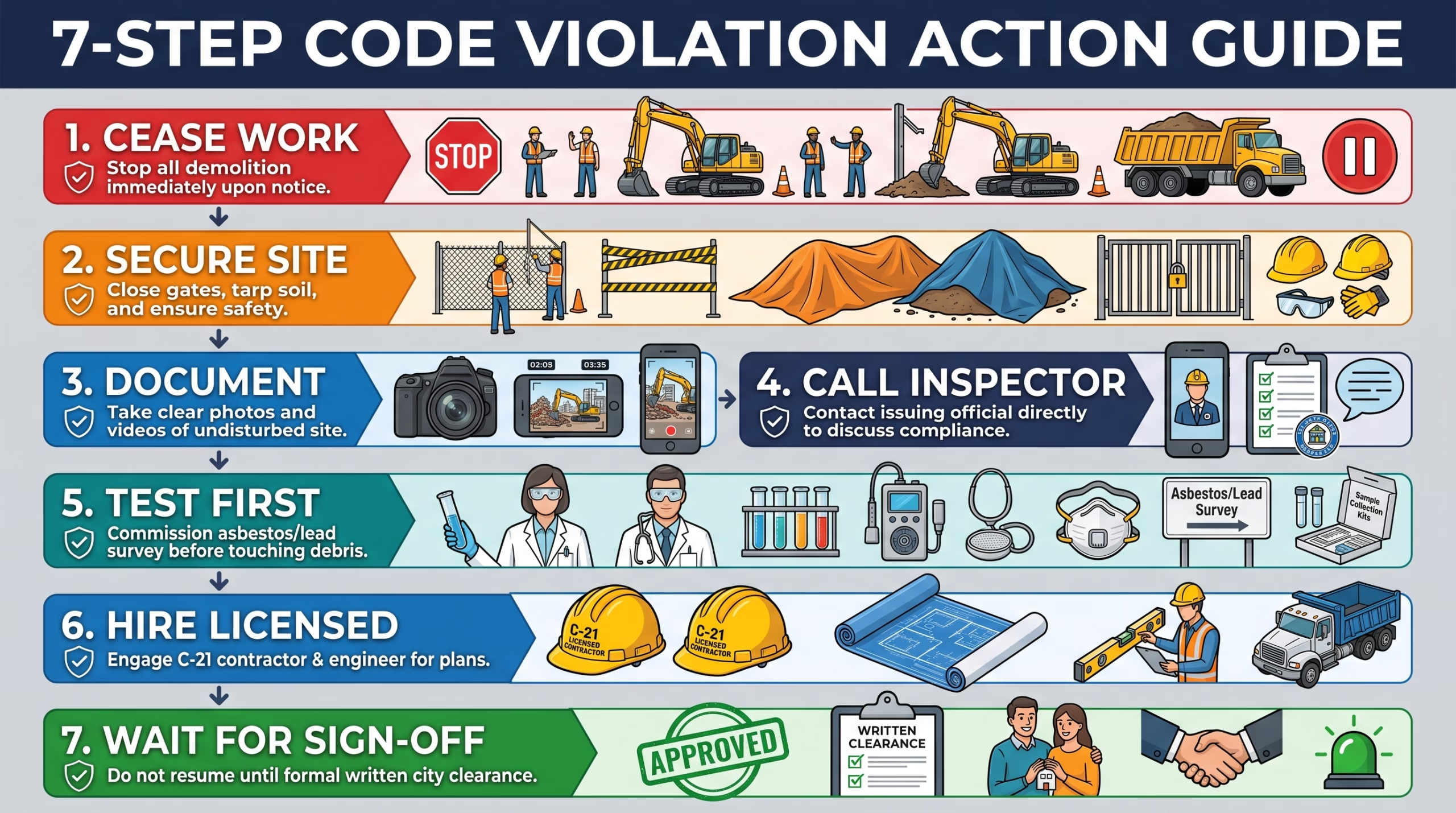
- CEASE WORK: Stop all demolition immediately upon receiving a notice.
- SECURE SITE: Close gates, tarp exposed soil, and ensure public safety.
- DOCUMENT: Take clear photos and videos of the undisturbed site.
- CALL INSPECTOR: Contact the issuing official directly to discuss compliance.
- TEST FIRST: Commission asbestos/lead surveys before touching debris.
- HIRE LICENSED: Engage C-21 contractors & engineers for plan submittal.
- DO NOT RESUME: Wait for written municipal authorization before resuming work.