Fact-Checked & Reviewed for Technical Accuracy
Reviewed for Accuracy
- Author: Bay Area Demolition and Hauling Editorial Team
- Reviewed by: John Alviter
- Reviewer Role: Founder & Lead Demolition Contractor
- Company: Bay Area Demolition and Hauling
- Google Business Profile: Bay Area Demolition and Hauling
- Review Snapshot: As of September 2026, our Google Business Profile shows 271 reviews with a 5.0 average star rating. Because review counts change, homeowners should check the live profile before hiring.
- CSLB License Number: #1123506
- License Classification: C-21 (Building Moving/Demolition)
- Last Reviewed: September, 2026
Review Scope
- California Contractors State License Board (CSLB)
- California Department of Insurance (CDI)
- California Business and Professions Code
- Municipal building department guidelines
When you plan a home renovation, tearing down an old structure looks simple at first glance. A crew pulls up, breaks down a worn building, loads the debris into a truck, and drives off.
However, demolition is actually one of the most technical phases of any construction project. Tearing down a heavy garage, breaking up concrete, or removing an old shed involves active power lines, gas pipes, heavy machinery, and strict city waste rules.
Homeowners comparing quotes often ask us a fair question: “How do I know these estimates are accurate, and how do I know a contractor is legitimate?”
The difference between a licensed, insured professional and an unverified operator isn’t just about price. It is the difference between a smooth site cleanup and an unexpected problem with utility lines, property damage, or unpaid bills.
This guide explains how to check a demolition contractor’s license, verify insurance policies, confirm city permits, and protect your property from start to finish.
Who This Guide Is For
This guide is written for California homeowners comparing contractor bids for detached garage demolition, backyard shed removal, interior selective demolition, concrete pad removal, or similar residential teardowns. Whether you are clearing space for an Accessory Dwelling Unit (ADU) or opening up your yard, these screening steps help keep your project on track.
What This Guide Does Not Cover
This article offers general screening steps. It does not replace project-specific advice from the CSLB, your local building department, your insurance agent, or your utility companies.
Quick Verification Checklist
Before you sign a contract or hand over a deposit, run through these eight quick steps:
-
-
- Get the Legal Business Name: Ask for the contractor’s legal business name, physical office address, and CSLB license number.
- Search the License on CSLB: Look up the license on CSLB.ca.gov to confirm it is active and in good standing.
- Check the Classification: Confirm that the license classification (such as C-21) fits your specific demolition job.
- Match Names Across Documents: Make sure the business name matches word-for-word on the license, quote, contract, insurance certificate, and payment request.
- Check Bond & Workers’ Comp: Verify on the CSLB site that the contractor holds an active $25,000 bond and check their Workers’ Compensation status.
- Request a COI: Ask the contractor to have their insurance agent send you a Certificate of Insurance (COI) listing you as the Certificate Holder.
- Call the Insurance Agent: Call the insurance broker listed on the certificate using an independently looked-up phone number to confirm the policy is active.
- Put Responsibilities in Writing: Ensure your contract clearly states who handles city permits, utility disconnections, waste recycling, and final cleanup.
-
Pro Tip: If any single check fails or leaves you with unanswered questions, pause the hiring process before signing or paying.
Why Contractor Verification Matters in Demolition
Demolition carries unique physical and legal risks. Taking a few minutes to check a contractor’s paperwork helps establish a clear paper trail before machinery touches your property.
1. Worker Safety & Injury Risks
Demolition involves heavy materials, sharp debris, power tools, and overhead framing. If a contractor works without proper Workers’ Compensation or uses unverified day labor, an injury on your property can lead to complicated insurance disputes or personal injury claims.
2. Property & Neighboring Boundary Protection
Teardowns happening near property lines, shared fences, or neighboring homes require careful control. Uninsured operations or improper wall bracing can crack driveways or damage neighboring structures.
Verifying general liability coverage gives you a way to confirm that a commercial policy exists before work begins. Covered damage is still subject to policy terms, exclusions, and claims handling, so ask the broker or carrier to confirm that the certificate reflects demolition operations.
3. Utility Line Hazards
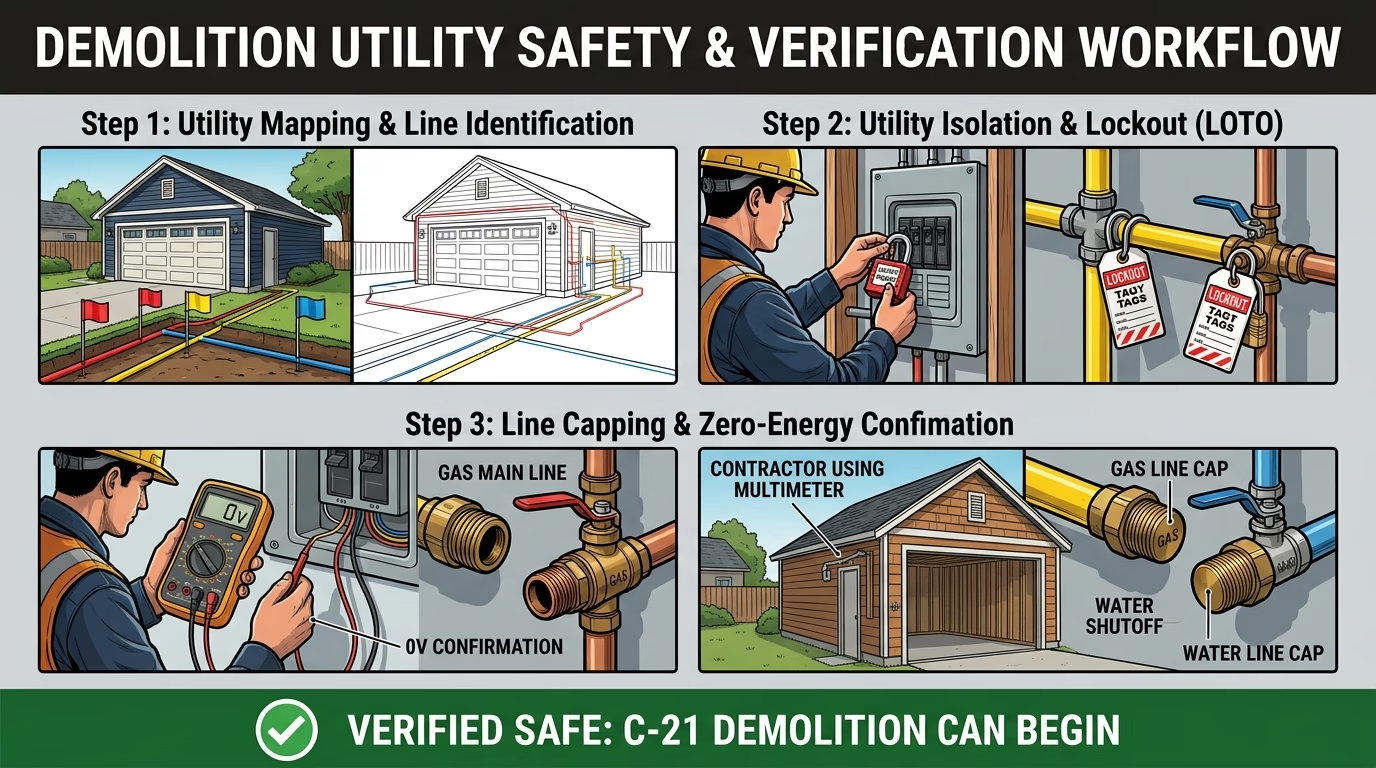
Most backyard structures connect to active utilities, such as 240V power subpanels, overhead electrical wires, gas lines, or water pipes. Striking an active gas pipe or live electrical wire creates immediate safety hazards. Verified contractors follow strict utility mapping and shutoff steps before tearing down walls.
4. Waste Disposal & Local Recycling Laws
California and local jurisdictions impose C&D diversion and recycling requirements on many permitted construction and demolition projects. Requirements vary by city and project type, so ask where debris will go and whether the contractor will provide C&D weight tickets, recycling receipts, or diversion documentation when required. Illegal dumping can create enforcement problems for the project owner, so include the disposal destination in the contract.
Insider Field Note: When our crew evaluates a detached garage before demolition, we inspect the electrical subpanel, check for nearby gas meters, locate water supply valves, measure side-yard fence clearances, and verify truck access paths before equipment arrives.
To avoid costly fines and legal issues from demolition companies that cut corners, California homeowners should follow a 7-step verification process when selecting a demolition contractor.
Step 1: Verify the CSLB License and Business Entity
In California, construction and demolition work generally requires a license from the California Contractors State License Board (CSLB) whenever a project requires a building permit, uses employee labor, or totals $1,000 or more in combined labor and materials (Source: California Business and Professions Code § 7048).
How to Check a License
-
-
- Go directly to the state portal at CSLB.ca.gov.
- Click on “License Check”.
- Type in the contractor’s license number or legal business name.
-
What to Look For on CSLB
- License Status: Make sure it says “Active” (not expired, suspended, or inactive).
- Entity Type: See if the business is registered as a Sole Owner, Corporation, LLC, or Partnership.
- Classifications: Check which trade licenses the company holds.
- Contractor Bond: Confirm an active $25,000 contractor’s bond is on file.
- Workers’ Comp Status: See if active Workers’ Compensation is listed or if an exemption is filed.
Safety Warning: Never rely only on a license number printed on a truck door, business card, or estimate. Always verify the number yourself directly on the state CSLB website.
What an Active License Does (and Doesn’t) Prove
-
-
- What it proves: An active license shows that the contractor passed state law and trade exams, met experience requirements, and maintains a mandatory bond.
- What it doesn’t prove: A license alone does not prove that the company carries commercial liability insurance, that their specific trade classification covers your exact project, or that a salesperson is an authorized employee.
-
Step 2: Confirm the License Classification Fits the Work
Demolition projects require specific trade authority based on the size and type of the structure.
C-21 Building Moving/Demolition Specialty License
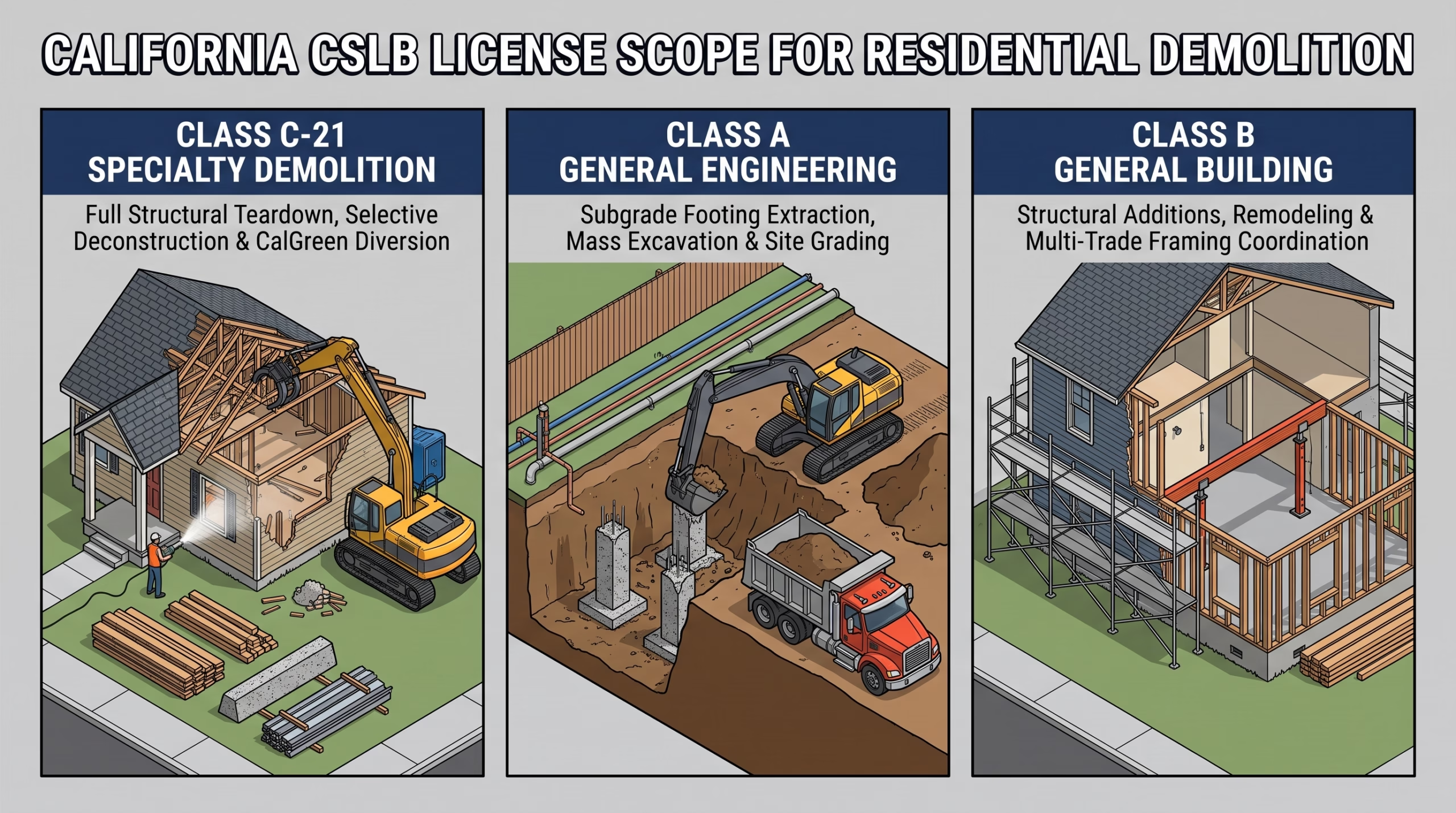
The C-21 (Building Moving/Demolition) classification is CSLB’s primary license for structural teardowns. CSLB defines C-21 work as raising, lowering, underpinning, demolishing, moving, or removing structures and foundations.
Note: CSLB rules state that a C-21 license does not cover building additions, alterations, or repairs to parts of a building that will stay standing.
General Engineering (Class A) & General Building (Class B)
-
-
- Class A (General Engineering): Covers heavy engineering projects, earthmoving, deep excavation, and large site clearing.
- Class B (General Building): Covers general home construction and framing. A Class B contractor may perform demolition if the teardown is part of a larger, multi-trade framing or building project.
-
| Project Type | What Classification to Look For | Why It Matters |
|---|---|---|
| Detached Garage or Shed Removal | C-21 or appropriate classification | Confirms legal authority to dismantle full structures and foundations. |
| Concrete Slab & Footing Removal | C-21, Class A, or C-8 Concrete | Ensures machinery operators are trained for heavy concrete breaking. |
| Interior Selective Demolition | C-21, Class B, or trade specialty | Protects plumbing, wiring, and framing in the rest of the home. |
| Utility-Connected Structures | C-21 with utility coordination | Confirms experience working around capped utility lines. |
| Pre-1978 Structures | C-21 with environmental checks | Requires knowledge of safe handling for older materials. |
Pro Tip: If a contractor’s CSLB classification doesn’t seem to match your job, ask them to explain their license scope in writing before you sign.
Step 3: Match the Business Name Across Every Document
One of the simplest ways to verify a business is to make sure their legal name is identical on all paperwork.
The Exact Name Match Rule
Check that the business name matches word-for-word across these documents:
-
-
- State CSLB License Portal
- Written Quote and Estimate
- Demolition Contract
- Certificate of Insurance (COI)
- Final Invoices
- Company Website
- Google Business Profile
- Bank Account or Check Payee Name
-
What About DBAs? A name difference isn’t always a dealbreaker—some companies legally use a “Doing Business As” (DBA) name. However, any name variation should be documented clearly in writing before you pay a deposit.
The “Friend or Cousin’s License” Trap
If someone says, “I’m working under my friend’s license,” or “My partner has the license, I just run the job,” hold off on hiring them. Under California law, a contractor’s license belongs strictly to the registered business entity. Coverage cannot be passed along to independent workers or unverified sub-crews.
Step 4: Verify Insurance Directly With the Broker or Carrier
A Certificate of Insurance (COI) is a brief summary showing policy limits as of the date it was printed. Because a printed sheet can become outdated, homeowners should verify policy status directly with the insurance broker.
The California Department of Insurance (CDI) recommends that homeowners request a COI showing the insurance carrier’s legal name, policy number, and active coverage limits.
The 3 Core Insurance Policies
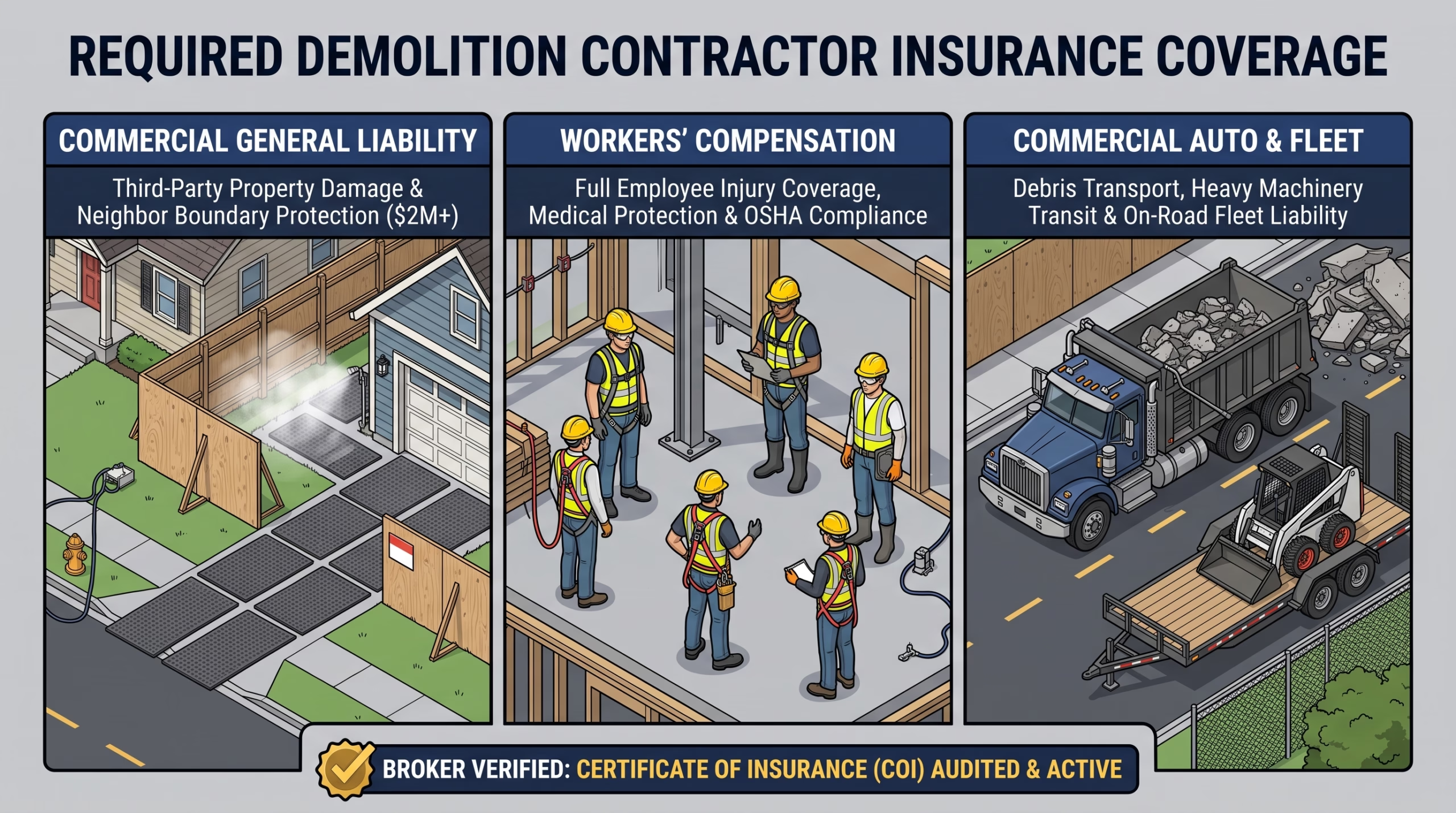
1. Commercial General Liability
Helps cover third-party property damage or injuries resulting from demolition work, subject to policy terms and exclusions.
2. Workers’ Compensation
Helps cover employee job-site injuries when the contractor is required to carry coverage. If the contractor has employees, verify active Workers’ Compensation coverage on CSLB and on the insurance certificate. If the contractor claims an exemption, confirm it matches who will actually be working on site.
3. Commercial Auto Insurance
Can cover heavy dump trucks, hauling trailers, and commercial equipment operating on your driveway and street.
How to Verify a Policy in 4 Steps
-
-
- Ask for an Official COI: Request a COI listing your name and home address in the “Certificate Holder” box.
- Find the Producer/Broker Box: Look at the top left of the form under “PRODUCER” to find the insurance agency’s name.
- Look Up the Broker’s Number: Search online for the insurance agency’s official phone number. Do not rely on a cell phone number written on the estimate.
- Call to Confirm: Call the broker to verify that the policy is active and covers commercial demolition.
-
Easy Call Script:
“Hi, I am reviewing a Certificate of Insurance for [Contractor Business Name] for demolition work at [My Address]. Can you confirm that Policy Number [X] is currently active and covers commercial demolition?”
Step 5: Confirm Workers’ Compensation Status Matches the Crew
Workers’ Compensation is essential during structural teardowns because of the heavy materials and tools involved.
How Workers’ Comp Rules Apply
If a contractor has employees, verify that an active Workers’ Compensation policy is recorded on CSLB and listed on the insurance certificate.
If CSLB shows a Workers’ Compensation Exemption, ask who will actually perform the work and whether any employees, helpers, day laborers, or subcontractors will be on site.
Example questions:
-
-
- Will you be doing all the physical work yourself?
- Will additional crew members or helpers be on site?
- If you bring in subcontractors, do they carry their own verified license and Workers’ Comp?
-
Takeaway: A Workers’ Compensation exemption may be acceptable for a true sole operator in a classification where CSLB allows an exemption, but the exemption must match the real job-site arrangement. If employees, helpers, day laborers, or subcontractors will be on site, ask how each worker is covered and verify that coverage before work begins.
Step 6: Confirm Permit, Utility, and Debris Responsibilities
Permit and recycling rules vary by city across the Bay Area. Detached garages, foundation removals, utility-connected structures, and street dumpsters often require local review, but exact requirements depend on the city, project scope, and where equipment or debris boxes will be placed.
1. Permit Responsibilities
-
-
- [ ] Who confirms whether a city demolition permit is required?
- [ ] Who submits the application to the local building department?
- [ ] Who covers the permit fees?
- [ ] Who schedules the final city site inspection?
- [ ] Is anyone asking you to pull an “Owner-Builder” permit? (Note: Pulling an owner-builder permit transfers primary legal and safety responsibility onto you as the homeowner).
-
2. Utility Line Safety
-
-
- [ ] Electrical: Locate subpanels, shut off breakers, and disconnect feeds.
- [ ] Gas: Shut off natural gas lines and cap them at the supply valve.
- [ ] Water & Plumbing: Shut off utility sinks, hose bibbs, and irrigation lines.
- [ ] Written Confirmation: Put utility isolation steps in the contract before work begins.
-
3. Waste Disposal & Recycling
-
-
- [ ] Confirm where demolition waste will be hauled.
- [ ] Ensure compliance with local CalGreen recycling standards.
- [ ] Ask for disposal facility weight tickets when the job is done.
- [ ] Check if a street encroachment permit is needed if a debris box sits on the road.
-
Bay Area Municipal Permit & Demolition Directory
Permit requirements, plan reviews, and building safety guidelines vary by city. Use this local directory to check building permit portals directly and explore our local demolition services in your community:
Santa Clara County
-
-
- Campbell: [
 BADH Campbell Services ] | [ Campbell Permit Portal ↗ ]
- Cupertino: [ BADH Cupertino Services ] | [ Cupertino Permit Portal ↗ ]
- Gilroy: [ BADH Gilroy Services ] | [ Gilroy Permit Portal ↗ ]
- Los Gatos: [ BADH Los Gatos Services ] | [ Los Gatos Permit Portal ↗ ]
- Milpitas: [ BADH Milpitas Services ] | [ Milpitas Permit Portal ↗ ]
- Morgan Hill: [ BADH Morgan Hill Services ] | [ Morgan Hill Permit Portal ↗ ]
- Mountain View: [ BADH Mountain View Services ] | [ Mountain View Permit Portal ↗ ]
- Palo Alto: [ BADH Palo Alto Services ] | [ Palo Alto Permit Portal ↗ ]
- Santa Clara: [ BADH Santa Clara Services ] | [ Santa Clara Permit Portal ↗ ]
- Saratoga: [ BADH Saratoga Services ] | [ Saratoga Permit Portal ↗ ]
- Sunnyvale: [ BADH Sunnyvale Services ] | [ Sunnyvale Permit Portal ↗ ]
- Campbell: [
-


San Mateo County
-
-
- Atherton: [ BADH Atherton Services ] | [ Atherton Permit Portal ↗ ]
- East Palo Alto: [ BADH East Palo Alto Services ] | [ East Palo Alto Permit Portal ↗ ]
- Menlo Park: [ BADH Menlo Park Services ] | [ Menlo Park Permit Portal ↗ ]
- Redwood City: [ BADH Redwood City Services ] | [ Redwood City Permit Portal ↗ ]
- Atherton: [
-
Santa Cruz County
-
-
- Santa Cruz: [ BADH Santa Cruz Services ] | [ Santa Cruz Permit Portal ↗ ]
- Santa Cruz: [
-
Step 7: Check Reputation and Local Project Evidence
Checking a company’s recent work helps confirm their experience with residential demolition in your local area.
Practical Checks
-
-
- CSLB Display: Look for their CSLB license number on their website and trucks.
- Local Presence: Verify a physical office or service area in the areas we serve.
- Real Job Photos: Look for recent photos showing safety gear, dust barriers, trucks, and clean job sites.
-
| Positive Review Signs | Warning Signs |
|---|---|
| Mentions specific city permits and inspections. | Vague feedback lacking project details. |
| Notes protection for fences, driveways, and plants. | Identical review text copied across multiple sites. |
| Praises clear communication during utility shutoffs. | Reviews focus on totally unrelated handyman tasks. |
| Mentions thorough magnetic sweeps for nails. | No recent local project photos shown. |
Lead-Gen Middlemen: Some directory websites collect quote requests and sell them to unvetted third parties. Always verify the specific company that signs your contract, runs the job site, and accepts payment.
Red Flags That Mean You Should Pause or Walk Away
If you spot any of these red flags during quote reviews, pause until written documentation clears things up:
| Red Flag | Potential Risk | Why You Should Pause | What to Ask Next |
|---|---|---|---|
| 1. Missing or Expired CSLB License | Unlicensed contracting violates CA law. | Work may be delayed, corrected, or stopped if required licensing or permits are missing. | “Can you provide your CSLB license number for verification?” |
| 2. Name Mismatch Across Documents | The proposal name differs from the CSLB or bank payee. | Causes contract and insurance issues. | “Can you provide documentation explaining this business name difference?” |
| 3. Excessive Upfront Deposit | Exceeds CA limits ($1,000 or 10%, whichever is less). | Increases financial exposure upfront. | “Can we adjust the deposit to match CSLB contract guidelines?” |
| 4. Refusal of a Written Contract | Verbal quotes offer zero legal protection. | Unclear scope, cleanup, and costs. | “Please provide a detailed written contract before we start.” |
| 5. Unverified Insurance Documents | Lapsed or missing insurance policies. | Leaves property damage risks on you. | “Please have your insurance agent send a COI naming me as Certificate Holder.” |
| 6. Workers’ Comp Crew Mismatch | Exempt license used with a multi-person crew. | Potential worker injury disputes. | “Who will be working on site, and how are they covered?” |
| 7. “No Permit Needed” Claims | Skipping required city approvals. | Unpermitted work can lead to correction notices, fines, inspection issues, or permit delays, depending on local enforcement. | “Have you verified permit requirements with the local building department?” |
| 8. No Written Utility Isolation Plan | Demolishing without verifying line capping. | Risk of line breaks, fires, or leaks. | “What is the written plan for capping electric, gas, and water lines?” |
| 9. Unclear Waste Destination | No clear disposal plan. | Exposure to illegal dumping fines. | “Which certified recycling facility will receive the waste?” |
| 10. Unvetted Subcontractors | Unclear who is running the site. | Confusion over liability and pay. | “Will subcontractors be used, and are their licenses verified?” |
Contractor Audit Comparison Matrix
Use this side-by-side matrix when comparing contractor quotes:
| Audit Factor | Professional Standard | Unverified Operator | Evidence to Request |
|---|---|---|---|
| CSLB License Status | Active status verified on CSLB.ca.gov. | Inactive, expired, or borrowing a license. | CSLB License Number |
| Classification Fit | Holds C-21 or scope-appropriate license. | Classification doesn’t cover demolition. | CSLB Public Record |
| Entity Name Match | Identical name on CSLB, contract, and COI. | Discrepancies across documents. | Written Name Explanation |
| Contractor Bond | Active $25,000 bond verified on CSLB. | Bond lapsed or suspended. | CSLB Bond Record |
| General Liability | Active policy verified with broker. | Unverified paper or lapsed policy. | Broker-Issued COI |
| Workers’ Comp | Active policy or verified sole operator. | Exempt status used with a crew. | COI / Written Crew Plan |
| Permit Handling | Coordinates permits with city building dept. | Pushes homeowner to pull owner-builder permits. | Written Permit Agreement |
| Utility Protocol | Written line isolation plan before teardown. | Begins teardown without line checks. | Written Utility Plan |
| Waste Disposal | Hauls waste to certified C&D facilities. | Unclear disposal locations. | C&D Facility Receipts |
| Written Contract | Detailed scope, schedule, and payment terms. | Verbal quote or vague invoice. | Signed Written Contract |
| Deposit Terms | Follows CA rule (max $1,000 or 10%). | Demands 30%–50%+ upfront. | Written Payment Schedule |
A 10-Minute Contractor Verification Walkthrough
Set aside 10 minutes to run through this step-by-step audit:
-
-
- Minute 1: Gather Details — Write down the business name, CSLB license number, phone number, and physical office address.
- Minutes 2–3: Check CSLB — Go to CSLB.ca.gov to verify license status, C-21 classification, bond status, and Workers’ Comp records.
- Minutes 4–5: Compare Names — Make sure the legal business name matches across the CSLB portal, quote, website, and payment terms.
- Minutes 6–7: Request COI & Draft Contract — Ask for a broker-issued COI naming you as Certificate Holder and request a draft contract.
- Minute 8: Review Permits & Utilities — Confirm who handles city building permits and review utility shutoff protocols.
- Minute 9: Check Waste Handling — Confirm where debris will go and ask if C&D recycling receipts will be provided.
- Minute 10: Make Your Decision — Move forward if all paperwork matches; pause if you find unexplained differences.
-
What to Do If Something Doesn’t Check Out
If your verification steps reveal unexplained differences or unverified details, take these calm steps:
-
-
- Pause Payments: Don’t sign contracts or issue deposits until paperwork is clear.
- Ask for Written Clarification: Ask the contractor to explain name differences or missing documents in writing.
- Verify Directly: Contact the CSLB at CSLB.ca.gov or call the listed insurance broker directly.
- Report Unlicensed Contracting: If an unverified operator performs unlicensed contracting, file a report with CSLB’s Statewide Investigative Fraud Team (SWIFT).
- Report Suspicious Insurance: If you receive a forged or altered insurance form, report it to the California Department of Insurance (CDI).
- Consult City Officials: If unpermitted work has already started on your property, call your local building department for guidance.
-
Why Homeowners Choose Bay Area Demolition and Hauling
At Bay Area Demolition and Hauling, we believe in complete transparency before any equipment arrives at your home.
Verification & Reputation
We encourage homeowners to run the same checks on Bay Area Demolition and Hauling that this guide recommends for any contractor.
-
-
- CSLB License: #1123506
- License Classification: C-21 Building Moving/Demolition
- Public CSLB Record: CSLB License #1123506
- Google Business Profile: Bay Area Demolition and Hauling
- Review Snapshot: As of September 2026, our Google Business Profile shows 271 reviews with a 5.0 average star rating. Because review counts change, homeowners should check the live profile before hiring.
- Name-Match Check: Before signing, confirm that the business name on your estimate, contract, insurance certificate, invoice, and payment recipient matches the company information you verified.
-
Our Job-Site Standards
Once we verify the paperwork, the next question is how the contractor plans to run the demolition safely and cleanly. Our residential demolition process centers on a clear scope, utility planning, debris control, and site turnover.
-
-
- Written Scope Before Work Starts: We define the structure, concrete, hauling, cleanup, exclusions, and payment schedule in writing.
- Utility Safety First: We review electrical, gas, water, and access conditions before teardown begins.
- Permit Responsibility in Writing: We clarify who handles city permit requirements before the project starts.
- C&D Debris Handling: We sort and haul eligible materials to appropriate local facilities, with weight tickets available upon request when applicable.
- Clean Site Turnover: We leave the work area flat, cleared of demolition debris, and magnet-swept for nails and small metal fragments where appropriate.
-
Whether you are planning a full structure teardown, garage demolition, or backyard shed removal, the goal is the same: make sure the license, insurance, contract, crew setup, permit plan, and project scope all match before work begins.
Frequently Asked Questions
How do I know if my demolition project requires a permit in California?
Permit requirements depend on your local city and project scope. Detached garages, house additions, accessory structures, foundation removals, utility connections, and street dumpsters typically require review by your local building department. Always confirm rules with your city building department before you start work.
What happens if a contractor damages a neighbor’s fence or driveway?
If you hire a contractor with active Commercial General Liability insurance, their policy can respond to covered third-party property damage, subject to policy terms. Verify the contractor’s policy with their insurance broker before work begins.
Can a handyman perform demolition work in California?
Under California Business and Professions Code § 7048 (updated under AB 2622), minor work under $1,000 may be exempt from licensing only if the project does not require a building permit, does not use employee labor, and is not part of a larger job. Because structural teardowns, concrete breaking, and utility connections usually require permits or machinery, verify CSLB licensing.
What if a contractor has an active CSLB license but the name on my quote is slightly different?
Pause the process. Ask for written documentation explaining the relationship between the business names (such as an official DBA filing). Do not issue payments until the CSLB record, quote, contract, insurance certificate, and payment recipient align.
Should I pull the demolition permit myself as an “Owner-Builder”?
Pulling an owner-builder permit places direct legal responsibility for safety, worker coverage, and building code compliance on you as the property owner. Having your licensed contractor pull the permit ensures they remain the primary party of record for construction compliance.
What documents should I have in hand before paying a deposit?
At a minimum, ensure you have a signed written contract, CSLB license verification, a broker-issued COI listing you as Certificate Holder, Workers’ Comp verification, permit responsibility terms, utility shutoff terms, and a payment schedule matching CSLB deposit rules.
Is a very low demolition quote a red flag?
Not always, but you should audit an unusually low quote carefully. Verify that the estimate includes city permit fees, proper utility shutoffs, legal waste recycling fees, and full insurance coverage rather than taking shortcuts on safety.
Final Checklist Before You Sign
Run through this final check before signing your contract:
-
-
- [ ] I verified the CSLB license status directly on CSLB.ca.gov.
- [ ] The license classification fits the demolition job.
- [ ] The legal business name matches across all project documents.
- [ ] The contract is written, detailed, and includes cleanup terms.
- [ ] The deposit requested complies with CA limits (max $1,000 or 10%).
- [ ] The broker sent the COI directly and named me as Certificate Holder.
- [ ] I verified Workers’ Comp status relative to the actual crew arrangement.
- [ ] Permit handling and utility shutoff responsibilities are in the contract.
- [ ] The waste disposal destination and recycling plan are defined.
-
Closing Principle: The lower-risk contractor is the one whose license, insurance, contract, crew setup, permit plan, and project scope all match before work begins.
Our Advice: Before hiring any demolition contractor (including us), run through the verification steps above. A legitimate contractor should be comfortable with that audit.